












































 Where To Buy
The surface onto which the product is to be applied should be scabbled to remove laitance and expose aggregate. Do not use bush hammers or similar preparation equipment that can crush the aggregate but leave it in place. The substrates must be sound, clean, dust free and free from all traces of oil, curing compound, gypsum, paint, corrosion deposits or algae, laitance which would impair adhesion.
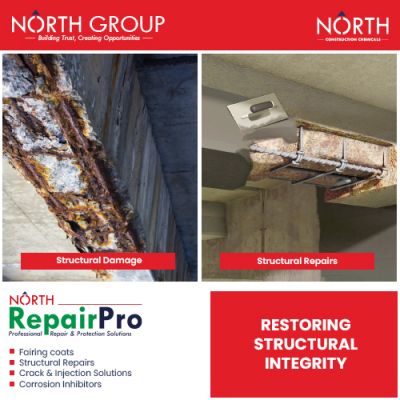
Remove degraded and or loose concrete until the substrate is solid, resistant and rough. Any previous restoration work which is not soundly bonded should also be removed. The damaged areas of concrete to be removed should be clearly identified. In certain instances where there is a significant loss of section, the steel may have to be replaced. Defective areas should have a 20mm deep saw cut made around the perimeter. Cut back all defective concrete to a sound base. Feather edging must be avoided. Feather-edging is not permitted and a minimum thickness of 20mm must be maintained over the whole repair area. Reinforcing steel should be exposed and cleaned around its whole circumference.
Clean the concrete and reinforcing steel by sand- blasting or other approved abrasive methods, to remove all dirt, rust, cement laitance, grease, oil & previously applied paints. Extra protection to the reinforcement can be provided by use of corrosion inhibitor dependent upon the circumstances of use and requirement of the client. Severely corroded reinforcement may require replacement and the engineer must be consulted.
Care should be taken to ensure formwork is secure and watertight to prevent movement and leaking during the placing and curing of the product. This can be achieved by using foam rubber strip or mastic sealant beneath the constructed formwork and between joints The area should be free of excessive vibration. Where RepairPro MC is to be poured, ensure access is available and a head of pressure can be maintained. Seal drainage outlets and ensure formwork is secure to prevent movement and grout loss during placement. Air pressure relief holes should be provided to allow venting of any isolated high spots. Generally, the gap width between the perimeter formwork and the plate edge should not exceed 75 mm on the pouring side and 25 mm on the opposite side. It is advisable where practical to have no gap at the flank sides.
RepairPro MC placed within open time of BondPro EP (generally within 8 hours) at 25°C.
Pre-soaking:
Prime reinforcing steel with 2 coats of RepairPro ZR. The formwork should include outlets for pre-soaking. For a minimum of 2 hours prior to grouting, the prepared substrate should be thoroughly soaked, to a saturated but surface dry condition prior to application of the RepairPro MC to minimize absorption and to assist in the free flow of the grout. Soaking prior to placement is essential and provision should be made for drainage outlets. Before pouring, remove all excess water from the cavity. To facilitate the elimination of unabsorbed water, use compressed air if necessary. Ensure formwork is secure to prevent movement during placing & curing. The use of BondPro EP, epoxy bonding agent is recommended where high soluble salts are present in the parent concrete. BondPro EP epoxy bonding agent is recommended as it prevents migration to the repair of deleterious salts such as chlorides or sulphates as well as bonding new concrete to old. When BondPro EP is used, pre-soaking is not necessary, but care should be taken to ensure formwork is erected and